Last updated 2026-07-26
TL;DR
No DSIP product sold online is FDA-approved, and there's no official purity standard to test against. A real certificate of analysis (COA) from an independent lab should show HPLC purity, mass spec ID, and testing for endotoxins and heavy metals, dated within the last few months. Most listings show none of this. Human sleep efficacy data for DSIP is also thin and decades old, so purity alone won't make the product do what the name implies.
Is DSIP FDA-approved, and does that affect how it's tested?
No. DSIP (delta sleep-inducing peptide) has no FDA-approved drug application for any indication. It's not listed in the FDA's Orange Book, and it isn't sold legally as an over-the-counter supplement either, because a peptide administered by injection doesn't qualify under the Dietary Supplement Health and Education Act framework [1]. This matters for purity because FDA approval comes with mandated manufacturing standards: current Good Manufacturing Practice (cGMP) under 21 CFR Part 211, batch release testing, and inspection of the facility [2]. None of that applies here. A vendor can call a product "research grade" or "99% pure" without any government body checking the claim before it ships. Most DSIP sold online is labeled "for research use only, not for human consumption," which is itself a regulatory workaround. That label exempts the seller from drug manufacturing rules, but it also means nobody is verifying what's actually in the vial before it reaches a customer [3]. The absence of FDA oversight is the whole reason purity testing and COAs matter so much here. There's no floor.
What does a DSIP certificate of analysis (COA) actually show?
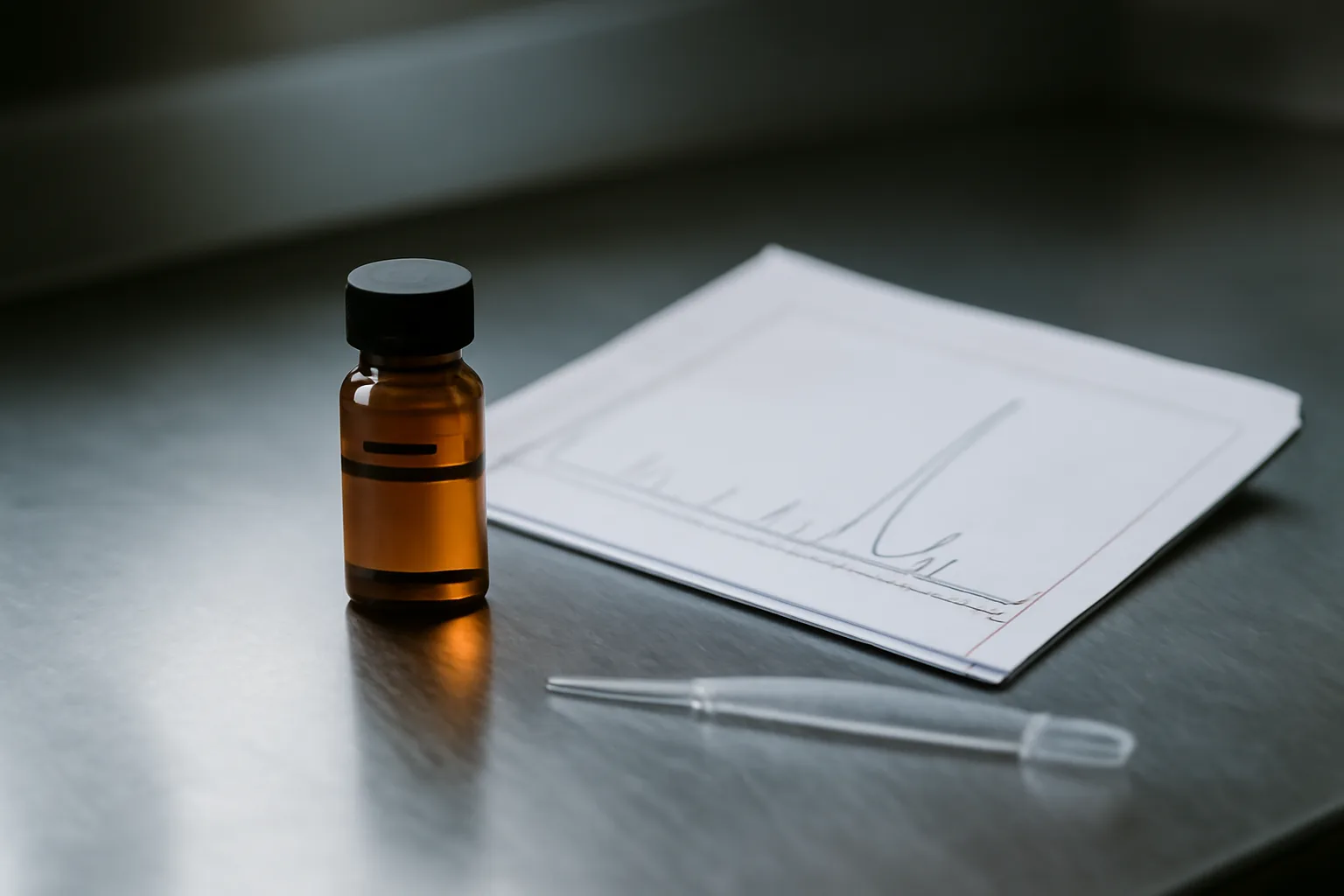
A real COA is a lab report on a specific batch or lot, not a generic marketing PDF. For a peptide, a legitimate one includes a few specific things. High-performance liquid chromatography (HPLC) purity: this measures what percentage of the material in the vial is the intended peptide versus degradation products or synthesis byproducts. Reputable research peptide COAs typically report purity in the high 90s (97 to 99%), verified by peak area under the HPLC curve. Mass spectrometry (MS) identity confirmation: HPLC purity tells you how clean the sample is, but not what the molecule actually is. Mass spec confirms the molecular weight matches DSIP's known sequence (Trp-Ala-Gly-Gly-Asp-Ala-Ser-Gly-Glu, molecular weight approximately 848.9 g/mol). Without MS, a 99% "pure" HPLC result could be 99% pure wrong peptide. Endotoxin testing (LAL assay): relevant for anything injected. Bacterial endotoxins from the manufacturing process can cause fever, chills, or worse if injected in sufficient quantity. The standard method is the Limulus Amebocyte Lysate (LAL) test, and results are reported in endotoxin units per milligram (EU/mg). Heavy metals and residual solvents: less commonly reported but relevant for peptides synthesized with solid-phase methods, which use reagents like trifluoroacetic acid (TFA) and can leave trace metal catalysts behind. A COA should also list: the specific lot number matching the vial you received, the testing lab's name (ideally third-party, not in-house), and a test date. If a vendor's COA has none of these specifics, a generic file that says "DSIP" with no lot number, it's not testing your product. It's decoration.
How do I tell a real independent lab report from a fake one?
Look for a named, findable laboratory. Legitimate third-party testing labs used in the peptide space (for example, Janoshik Analytical or similar independent chromatography labs) publish their own methodology and are searchable outside the vendor's website. If you can't verify the lab exists independently of the seller, treat the report skeptically. Check whether the lot number on the COA matches what's printed on your vial or shipping label. This is the single easiest fake to catch. Vendors sometimes post one real COA from one tested batch and use it to represent every batch they sell afterward, sometimes for years. If the COA is undated or the date is more than a few months old relative to your order, ask why. Be wary of COAs that only show a purity percentage and nothing else. A single number with no chromatogram image, no lot number, and no lab letterhead is trivial to fabricate in a spreadsheet. A real chromatography report includes the actual peak graph, more than a summary line. Some vendors will provide a COA only on request, or only for the specific batch you purchased, generated after your order ships. That's actually a decent sign; it suggests batch-specific testing rather than a static file reused for marketing.
What does "99% pure" actually mean, and can I trust the number?
"99% pure" almost always refers to HPLC purity, the percentage of peak area attributable to the intended peptide compound in that specific analytical run. It does not mean 99% of what's dissolved in the vial is DSIP relative to any labeled dose. It also says nothing about whether the peptide is degraded, misfolded, or whether the vial contains the amount of peptide printed on the label. Two separate things get confused constantly: purity (is the peptide clean) and content or potency (is there actually 5mg in a vial labeled 5mg). A peptide can be 99% pure by HPLC and still be underdosed by 30% if the manufacturer didn't weigh accurately or if degradation occurred during storage or shipping. Testing for actual peptide content requires a separate quantitative assay, and very few consumer-facing COAs include it. There is no independent, government-run purity standard for DSIP the way there is a United States Pharmacopeia (USP) monograph for many approved drugs. So "99% pure" is only as trustworthy as the lab that generated the number, and the honesty of the vendor in reporting it accurately.
What happens if I inject unpurified or contaminated DSIP?
The realistic risks fall into a few categories, and none of them are unique to DSIP specifically; they apply to any injectable peptide of uncertain provenance. Endotoxin exposure from bacterial contamination during synthesis or packaging can cause fever, chills, and injection site inflammation, and in more serious cases, a systemic inflammatory response. This is why LAL testing exists as a standard release criterion for injectable pharmaceuticals in the first place [2]. Incorrect concentration means you may be dosing far more or less than intended, since human dosing data for DSIP is itself extremely limited (see below) and there's no established therapeutic range to compare against. Degraded peptide, from poor storage, freeze-thaw cycling, or exposure to heat and light, may simply not have the intended biological activity, or may produce breakdown products with different, unstudied effects. Sterility is a separate issue from purity entirely. A peptide can be chemically pure and still be non-sterile if it wasn't lyophilized and packaged under sterile conditions. Look for whether the vendor mentions sterile filtration or aseptic processing, more than chromatography purity, since these address different failure modes. For a broader rundown of what's actually been reported with DSIP use, see DSIP peptide side effects.
Does third-party testing prove DSIP works for sleep?
No, and this is the gap that purity testing can't close. A clean, well-tested vial tells you what's in it. It tells you nothing about whether DSIP does what its name suggests for a human being trying to sleep better. The core human sleep trials on DSIP are old and small. A frequently cited study by Schneider-Helmert (1985) in a small group of patients with chronic insomnia reported some subjective sleep improvements with DSIP, but the sample size was limited and the study predates modern polysomnography and reporting standards common in sleep research today [4]. Much of the remaining evidence base is preclinical, meaning it comes from animal models, primarily rabbit and rat studies from the 1970s through 1990s examining EEG changes and delta wave activity, not human sleep outcomes [5]. An animal finding showing increased delta-wave EEG activity in a rabbit is not the same claim as "DSIP improves human sleep quality," and treating it as equivalent is a common overreach in marketing copy. If you want the full rundown of what the studies do and don't show, the honest version is on our DSIP evidence overview. Purity testing is a quality control question. Efficacy is a completely separate, and much less settled, question.
What's the difference between research-grade and pharmaceutical-grade DSIP?
"Pharmaceutical-grade" implies manufacturing under cGMP (21 CFR Part 211) with batch records, validated processes, and FDA-registered facility oversight [2]. As of now, there is no FDA-approved pharmaceutical DSIP product on the market in the US, so nothing sold to consumers can honestly carry that label. "Research-grade" or "research use only" (RUO) is the legal category almost everything sold online falls under. RUO products are explicitly not intended for human use, and the label exists specifically so the seller isn't held to drug manufacturing or clinical safety standards. In practice, RUO peptide quality varies enormously between vendors, from labs that genuinely run HPLC and mass spec on every batch, to operations that repackage bulk powder from unverified overseas suppliers with a printed label and nothing else. The route that carries clinical-level oversight is a compounding pharmacy working from a provider's prescription, where the pharmacy (not a research chemical seller) is responsible for USP-compliant compounding standards under state pharmacy board rules. That's a materially different supply chain than a website selling vials labeled "not for human consumption," and it's the direction we'd point someone who wants oversight rather than a spreadsheet-generated purity claim.
How should I dose DSIP if I've already decided to use it?
This isn't really a purity question, but it's the one that follows immediately after, so it's worth addressing briefly here. Human dosing data for DSIP is sparse; the older clinical literature used doses in the range of roughly 25 to 100 micrograms in small trial settings, but there is no FDA-established or consensus clinical dose, and no long-term safety data at any dose [4]. Because there's no standard dose, a purity or potency error in your specific vial compounds the underlying problem: you're already working from thin dosing evidence, and now layering uncertainty about how much peptide is actually in your syringe. For the specifics people ask about most, timing relative to sleep, injection method, and how long people run it, see DSIP dosage, how to take DSIP peptide, and DSIP injection sites. Cycle length questions (how long people use it before stopping) are covered separately in DSIP cycle length, since there's no official protocol there either, just common practice.
What red flags should I watch for when buying DSIP online?
A few patterns show up again and again in lower-quality listings, and they're worth checking before you buy, not after. No lot-specific COA, or a COA that's clearly a template reused across every product page on the site. Vague purity language like "pharmaceutical grade" or "99%+ pure" with no lab name attached. Pricing far below competitors for the same labeled quantity, which often correlates with cut corners in testing or synthesis quality, though price alone isn't proof either way. No mention of endotoxin testing anywhere on the product page, especially notable given DSIP is sold for injection. A company that won't answer a direct email question about which lab performed their testing, or answers vaguely. On the other side, decent signs include: a COA with a visible chromatogram graph (more than a summary number), a named third-party lab whose website you can find independently, a lot number that matches your shipment, and a reasonable, unexaggerated description of the evidence base rather than exaggerated sleep-cure language.
Where does the provider-reviewed route fit into this?
If the goal is oversight rather than a self-reported purity claim from a research chemical seller, the more accountable path is going through a licensed provider who reviews your situation and a compounding pharmacy that's responsible for USP-compliant compounding practices, rather than a website whose only quality control is a PDF it generated itself. DSIP Peptide's site is built around exactly that distinction: it doesn't compound or manufacture anything itself, but it reviews the provider route and names the fulfilling pharmacy partner so the sourcing chain isn't a black box. That's a different kind of accountability than a lot number on a spreadsheet, because a pharmacy license carries real regulatory consequences that an anonymous research chemical vendor doesn't face. Whatever route you take, the purity question and the efficacy question stay separate. A well-tested vial is a quality baseline, not proof the product will do what marketing implies for human sleep.
Frequently asked questions
Is DSIP legal to buy in the US?
It's sold legally as a "research use only" chemical, not as an approved drug or supplement. That label means it's not intended for human consumption under FDA rules, which is the loophole most vendors operate under. No DSIP product has FDA approval for any human use [1].
What purity percentage should I look for in a DSIP COA?
Reputable peptide vendors typically report HPLC purity in the 97 to 99% range, backed by a visible chromatogram and lot-specific documentation. A number alone with no chromatogram, lab name, or lot number isn't verifiable and shouldn't be treated as reliable.
Does a high purity percentage mean DSIP will help me sleep?
No. Purity tells you what's in the vial, not whether the peptide has meaningful effects on human sleep. The human efficacy evidence for DSIP is old, small in scale, and largely from the 1980s, so a clean vial doesn't resolve the separate question of whether it works [4].
What's the difference between HPLC purity and mass spec testing?
HPLC purity measures how clean the sample is relative to degradation byproducts, expressed as a percentage. Mass spectrometry confirms the molecule's identity by matching its molecular weight to DSIP's known sequence. You need both; HPLC purity alone can't confirm you actually have DSIP rather than a similar-weight compound.
Why does DSIP need endotoxin testing if other supplements don't?
DSIP is administered by injection, not orally, so bacterial endotoxin contamination is a direct route into the bloodstream. Endotoxin testing (typically an LAL assay, reported in EU/mg) is a standard release check for any injectable pharmaceutical, and its absence from a vendor's documentation is a meaningful gap [2].
Can I trust a COA posted on a vendor's website?
Only if it's lot-specific, dated, shows a chromatogram, and names an independent testing lab you can verify exists outside the vendor's own site. A generic PDF with just a purity percentage and no lot number is easy to fabricate and shouldn't be treated as proof for the batch you're buying.
Is there an FDA or USP purity standard specifically for DSIP?
No. Unlike many approved pharmaceuticals that have a United States Pharmacopeia (USP) monograph setting official purity and identity standards, DSIP has no such government or industry standard because it isn't an approved drug. Purity claims rely entirely on whatever testing an individual vendor chooses to do.
How old is the human research behind DSIP for sleep?
Most of it dates to the 1980s and 1990s. A commonly cited human study is Schneider-Helmert (1985), involving a small insomnia patient group, using methods that predate modern sleep study standards [4]. Much of the rest of the DSIP literature is preclinical animal research from the same era [5].
What does "research use only" actually mean legally?
It's a labeling category sellers use to indicate a substance isn't intended for human consumption, which exempts them from FDA drug manufacturing and marketing rules. It does not mean the product has been tested for human safety, and using an RUO product on yourself falls outside any regulatory safety framework.
Does cost correlate with DSIP quality?
Not reliably on its own, but unusually cheap pricing relative to competitors selling the same labeled quantity often correlates with reduced testing investment or lower-quality synthesis. Price is a weak signal at best; the COA specifics (lot number, lab name, chromatogram) matter far more than price comparison alone.
What should a legitimate DSIP vendor be willing to tell me?
The name of the third-party lab that tested the specific batch, the lot number, the test date, and the actual HPLC/mass spec results, more than a summary purity claim. A vendor unwilling to answer a direct question about their testing lab is a clear red flag.
Is compounded DSIP from a pharmacy different from research-chemical DSIP?
Yes. A compounding pharmacy operates under state pharmacy board oversight and USP compounding standards, with accountability a research chemical seller doesn't have. That's a materially different quality and safety chain than a website selling vials labeled "not for human consumption."
Sources
- FDA, Dietary Supplement Health and Education Act of 1994, Public Law 103-417: Injectable peptides like DSIP don't qualify as dietary supplements under DSHEA
- FDA, 21 CFR Part 211 (cGMP for Finished Pharmaceuticals): Pharmaceutical manufacturing requires cGMP compliance including batch testing and endotoxin release criteria
- FDA, guidance on research use only products: RUO labeling exempts products from human-use regulatory requirements
- Schneider-Helmert D, Neuropsychobiology (1985): Small human insomnia study using DSIP reported subjective sleep improvements, using older methodology
- Graf & Kastin, Peptides journal review on DSIP: Much of the DSIP research base consists of preclinical animal studies on EEG and delta-wave activity
- FDA, Orange Book (Approved Drug Products): DSIP has no FDA-approved drug listing