Last updated 2026-07-26
TL;DR
DSIP (delta sleep-inducing peptide) injection means reconstituting lyophilized powder with bacteriostatic water and giving it subcutaneously, usually before bed. Most protocols in the literature and research forums use roughly 100-250 mcg. Human sleep-architecture evidence is old, small, and mixed; a lot of the strongest data is from 1970s-80s animal and small human studies, not modern trials.
What is DSIP peptide injection and how does it differ from other forms?
DSIP (delta sleep-inducing peptide) is a nonapeptide, a chain of nine amino acids, first isolated from rabbit brain in the 1970s by a Swiss research group led by Monnier and Schoenenberger, who described a substance in the blood of sleeping rabbits that could induce delta-wave (slow-wave) sleep EEG patterns when transferred to another animal [1]. It is sold research-grade almost exclusively as a lyophilized (freeze-dried) powder in a small vial, because the peptide is not stable long-term in liquid form. Injection is the only route with any real research history. There is no published human pharmacokinetic data on oral DSIP absorption, and peptides this small and this fragile generally do not survive stomach acid and gut enzymes intact, which is why oral "DSIP" products are mostly speculative repackaging with essentially no evidence behind the oral route specifically. Nasal sprays and sublingual drops show up in the gray market too, but again, without study data behind those routes for this peptide. Subcutaneous (SubQ) injection is what nearly all research protocols and the older clinical studies used, typically into the abdominal fat or thigh, similar to how someone would inject insulin. This is not medical advice, and DSIP is not FDA-approved for any human use; it exists as a research chemical, and anyone handling it should treat it that way [2]. For background on the underlying research, see the main dsip overview page.
How do you reconstitute DSIP peptide powder correctly?
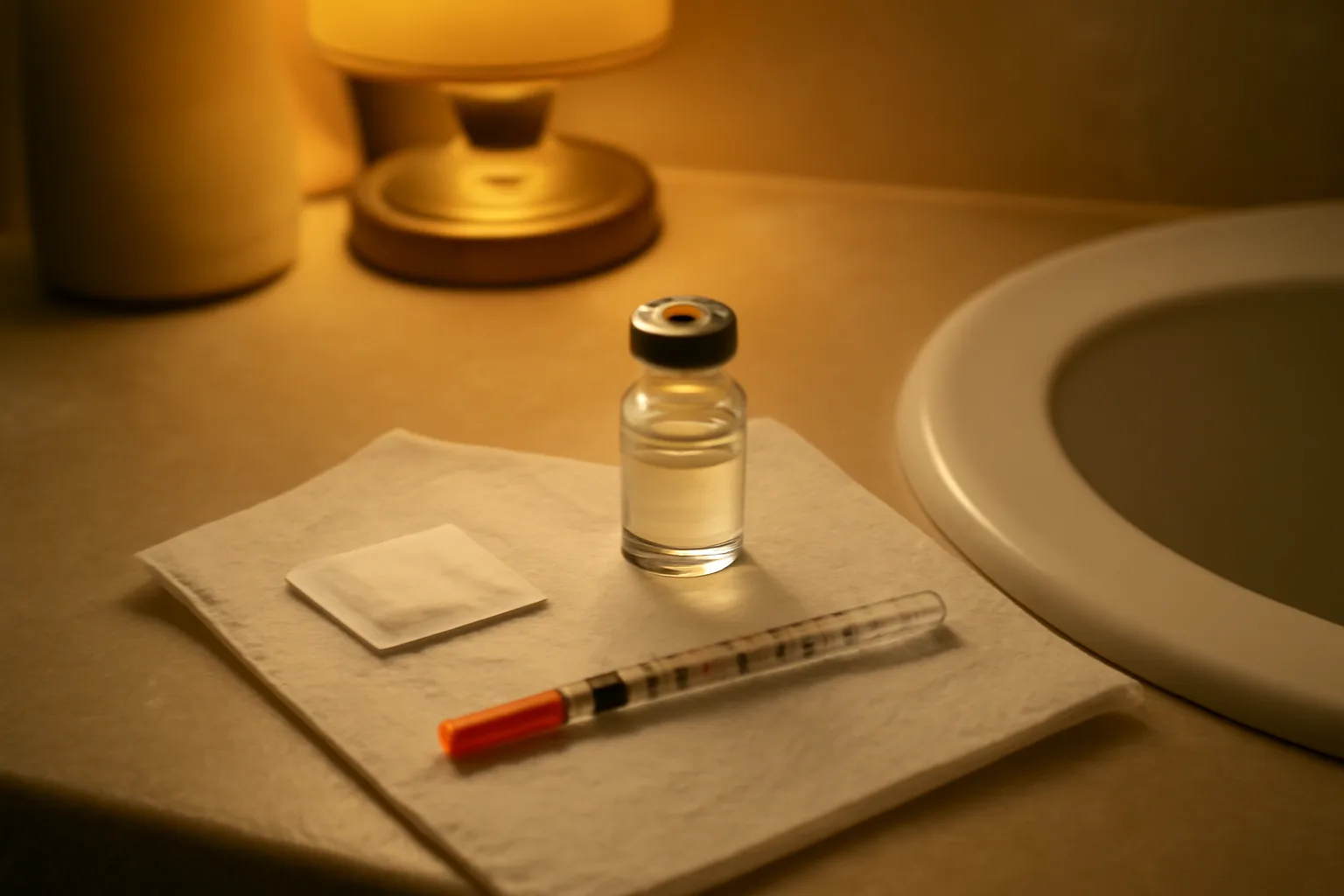
Reconstitution means turning the freeze-dried powder back into a liquid you can draw into a syringe. You do this with bacteriostatic water (water with 0.9% benzyl alcohol as a preservative), not plain sterile water, because bacteriostatic water lets the reconstituted vial last weeks in the fridge instead of needing to be used same-day. The general process: wipe the vial top with an alcohol swab, draw the bacteriostatic water into a syringe, and inject it slowly down the inside wall of the vial rather than directly onto the powder, which can damage the peptide structure and cause foaming. Let it sit until fully dissolved, swirling gently rather than shaking. A common approach for a 2 mg vial is to add 2 mL of bacteriostatic water, giving a concentration of 1,000 mcg/mL (1 mg/mL). At that concentration, a 100 mcg dose is 0.1 mL, which lines up with the 10-unit mark on a standard U-100 insulin syringe. If your vial is 5 mg, adding 5 mL gives you the same 1 mg/mL concentration and the same easy math. Always check the actual vial label; concentrations vary by supplier and this is just one common ratio, not a universal rule. Once reconstituted, DSIP solution should be kept refrigerated (roughly 36-46°F / 2-8°C) and protected from light and vibration/agitation, which can degrade the peptide over time. Manufacturer labeling for bacteriostatic water for injection states the product is intended for use within 28 days once a multi-dose vial is entered, which is the general shelf-life reference point most peptide handling guides borrow, though this figure comes from the water's own labeling, not from DSIP-specific stability studies [3]. For the numbers behind common dosing amounts, see the dsip dosage page and the dsip dosage calculator.
How do you actually do a DSIP peptide injection, step by step?
Wash your hands and clean the injection site (commonly lower abdomen, about two inches from the navel, or the outer thigh) with an alcohol swab. Let the area air-dry for a few seconds; injecting through wet alcohol can sting. Draw the calculated dose into an insulin syringe (typically a 0.3 mL or 0.5 mL, 29-31 gauge syringe works fine for small SubQ volumes). Pinch a fold of skin, insert the needle at roughly a 45-90 degree angle depending on your body fat at the site, and inject slowly and steadily. Withdraw the needle, apply light pressure with a clean gauze pad, and dispose of the needle in a proper sharps container, not the household trash. Most people who use DSIP for sleep research take it in the evening, often 30-60 minutes before intended sleep time, matching the timing logic from the original animal studies where the peptide's proposed role was tied to the natural nighttime rise in delta-wave sleep stages [1]. Rotate injection sites to avoid irritation if dosing daily or near-daily. Do not reuse needles, do not share vials or syringes, and do not inject into visibly bruised, scarred, or infected skin. If you notice redness that spreads, warmth, or swelling that worsens after 24-48 hours, that is not normal post-injection irritation and needs medical attention.
What does the actual human and animal research on DSIP for sleep show?
This is the part that gets glossed over in most marketing copy, so let's be straight about it. DSIP's origin story is genuinely animal research: Schoenenberger and Monnier's group isolated the peptide from dialysates of rabbit brain venous blood during induced sleep and showed it could promote EEG delta-wave activity when given to other rabbits, which is where the name comes from [1]. That is a real, published finding, but it is a rabbit study from the 1970s, not a human sleep trial. Human work exists but is old, small, and inconsistent. A frequently cited human study is Schneider-Helmert (1985) in the International Journal of Clinical Pharmacology, Therapy and Toxicology, which gave DSIP to a small group of patients with chronic sleep disturbances and reported some improvement in sleep quality measures, though the study population was small and the design would not meet current standards for a sleep-drug trial [4]. Other studies from the same era found DSIP affected some EEG parameters without reliably improving subjective sleep quality or sleep latency, and results across studies were inconsistent enough that no consensus on efficacy ever formed [5]. There is no modern (post-2000), adequately powered, placebo-controlled human trial establishing DSIP as an effective sleep aid. It never advanced through FDA drug development, and it does not appear as an approved insomnia treatment in any national formulary. If you see a claim that DSIP is "clinically proven" for sleep, that claim is overstating a thin, decades-old literature, not describing a settled scientific finding. For a fuller breakdown of individual studies, see dsip.
What is a typical DSIP peptide dosage for research use?
There is no FDA-established or medically standardized human dose because DSIP is not an approved drug. What exists instead is a rough range drawn from older clinical studies and from patterns reported in research-peptide communities, generally landing between 100 and 300 mcg per dose, with many protocols centering around 100-150 mcg taken in the evening [4][5]. Some of the original human studies used doses in a similar ballpark but delivered them differently (IV infusion in a clinical setting rather than SubQ self-injection), so translating those study doses directly into a home SubQ protocol involves guesswork, not a validated conversion. Frequency varies in anecdotal use from nightly to a few times per week, with some people cycling (for example, five days on, two days off) based on the theory that continuous use blunts response, though there is no controlled human data confirming or refuting tolerance patterns for this specific peptide. Because there's no regulatory dosing standard, anyone considering this should treat published amounts as historical reference points, not medical guidance, and should not scale doses up chasing a stronger effect; more peptide is not established to mean more benefit, and higher doses in a substance with this little human safety data just means more unknown. Full detail on this lives on the dsip dosage page.
How long does it take for DSIP to work after injection?
There isn't solid published human pharmacokinetic data (absorption timing, half-life, peak concentration) for subcutaneous DSIP specifically, which is itself a notable gap for a peptide that's been discussed since the 1970s. Older studies that measured effects were mostly using IV administration in clinical/lab settings, which behaves differently from an at-home SubQ shot in absorption speed. Anecdotally, people using SubQ DSIP for sleep report timing it 30 minutes to an hour before bed, with reported effects (drowsiness, faster sleep onset) sometimes described within that window, but this is self-report from unregulated use, not measured trial data, so take it as a starting point for personal experimentation, not a guaranteed timeline. Given the lack of formal absorption data, a cautious approach is to try dosing at a consistent time each night for at least several nights before drawing conclusions, since single-night reactions vary a lot with sleep pressure, caffeine timing, stress, and other confounds that have nothing to do with the peptide itself.
Does DSIP peptide injection have side effects or risks?
Documented adverse effects in the human literature are limited because the human literature itself is limited, but reported issues from older clinical studies and general peptide-injection risk include transient dizziness, changes in blood pressure, and mild gastrointestinal discomfort in some subjects [4][5]. Local injection-site reactions (redness, mild swelling, soreness) are a general risk with any SubQ peptide injection and are not DSIP-specific. Because DSIP has never gone through full-scale, modern human safety trials, there is no complete picture of rare side effects, drug interactions, or long-term use risk. That absence of data is not the same as a clean bill of safety; it just means nobody has systematically looked hard enough to say either way with confidence. Anyone with a bleeding disorder, current pregnancy or breastfeeding status, or an existing sleep or psychiatric medication regimen should treat this as a reason to talk to a doctor first, not a reason to self-experiment more cautiously and proceed anyway. A dedicated breakdown of reported reactions is on the dsip peptide side effects page.
Where should DSIP peptide injections be sourced from?
DSIP sold in the US is marketed almost exclusively under "research use only" labeling, meaning it is not sold, labeled, or intended for human consumption under FDA rules, and any supplier claiming otherwise is misrepresenting its regulatory status [2]. That labeling exists for a real regulatory reason: DSIP has not completed FDA review for safety and efficacy in humans. Quality control varies enormously between suppliers. Because the peptide-supply market is largely unregulated at the retail level, purity, actual peptide content versus label claim, and sterility of the lyophilized product can differ a lot from one vendor to the next, and there is no FDA approval process verifying any of it for this substance. The most defensible practice, if someone is going to source research-grade DSIP, is choosing a provider that publishes third-party certificates of analysis for the specific batch, and working with a route that connects to a pharmacy partner for fulfillment rather than an anonymous drop-shipper. DSIP Peptide's provider-reviewed sourcing page walks through what a vendor's documentation should actually include before you'd consider a batch legitimate; see buy dsip for that breakdown.
How does DSIP compare to other sleep-focused peptides or supplements?
| Compound | Evidence base | Typical route | Regulatory status |
|---|---|---|---|
| DSIP | Small, old human studies (1980s), animal origin | SubQ injection | Not FDA-approved, research use only [2] |
| Melatonin | Large modern human evidence base for circadian timing | Oral | FDA-regulated as a dietary supplement |
| Trazodone | Extensive clinical trial history, off-label insomnia use | Oral, prescription | FDA-approved (as an antidepressant; off-label for sleep) |
| Zolpidem (Ambien) | Extensive RCT history | Oral, prescription | FDA-approved for short-term insomnia |
The honest comparison is that DSIP sits in a different evidence tier than approved sleep medications or even melatonin. Melatonin has decades of modern randomized trials behind its use for circadian-rhythm-related sleep issues, reviewed extensively by the National Center for Complementary and Integrative Health [6]. Prescription hypnotics like zolpidem went through full FDA trial phases with defined dosing, contraindications, and monitored side-effect profiles. DSIP has neither. It has an interesting origin story, a handful of small mid-20th-century human studies with mixed results, and a research-chemical market that has run well ahead of the evidence. That doesn't mean it does nothing, but it does mean the comparison to approved sleep drugs isn't apples to apples; one category has been through FDA review, and the other hasn't been submitted for it at all.
Can DSIP peptide be used with other peptides or medications?
There is no published human interaction data for DSIP combined with other peptides, prescription sleep aids, SSRIs, blood pressure medications, or anything else, which means any combination protocol you see online is based on anecdote, not study data. Some research-peptide users stack DSIP with growth-hormone-related peptides or other recovery-focused compounds based on a theory that improved sleep quality supports the effects of those other peptides, but that reasoning is speculative extrapolation, not a tested interaction claim. If someone is on a prescribed sleep medication, an antidepressant, or a blood pressure medication, adding an unregulated research peptide on top introduces a genuinely unknown interaction risk, precisely because nobody has studied it. That is a conversation for a physician, not a peptide forum.
How should DSIP peptide injections be stored and handled?
Unreconstituted (still-powder) DSIP is generally more stable and can often be stored refrigerated or even frozen per the supplier's certificate of analysis, though exact stability data is supplier-specific rather than governed by a universal standard, since this isn't an FDA-monitored drug product. Once reconstituted, keep the vial refrigerated at roughly 36-46°F (2-8°C), out of direct light, and avoid shaking or agitating it. Bacteriostatic water's own labeling supports use of a reconstituted multi-dose vial for up to 28 days after first puncture, which is the reference point most peptide-handling guides use, understanding again that this comes from the diluent's stability data, not a DSIP-specific study [3]. Discard any vial that looks cloudy, discolored, or has visible particulate, and never use a vial past its practical use window even if it looks fine, since visual inspection alone can't confirm sterility or peptide integrity.
How to take DSIP peptide safely if you're going to try it anyway
If someone has decided to proceed despite the thin evidence base, the harm-reduction basics matter more than the exact dose. Use a new sterile syringe every time, never share vials between people, and always use a proper sharps container for disposal, which many pharmacies provide free or low-cost. Start at the lower end of commonly reported ranges (around 100 mcg) rather than the top of the range, track sleep quality with something objective like a wearable or a written sleep diary rather than relying purely on how you feel the next morning, and give it several consistent nights before deciding whether it's doing anything. Stop and see a doctor if you notice a spreading injection-site reaction, unusual dizziness, fainting, or any new symptom that doesn't resolve within a day or two. And keep in mind that self-reported "it worked for me" is exactly the kind of evidence that got DSIP oversold in the supplement market in the first place; a personal anecdote isn't a substitute for the clinical trial data that simply doesn't exist yet. The how to take dsip peptide page covers timing and logistics in more depth, and DSIP Peptide's provider-reviewed pages are built around exactly this kind of straight-line honesty about what is and isn't established.
Frequently asked questions
What is DSIP peptide injection used for?
DSIP (delta sleep-inducing peptide) injection is used in research settings, primarily around sleep and stress-response, based on 1970s-80s studies originating in rabbit brain research. It is not FDA-approved for any human condition, and the human sleep-benefit evidence is old, small, and mixed rather than strong or modern.
How do you reconstitute DSIP peptide powder?
Add bacteriostatic water to the lyophilized powder vial slowly, down the inside wall rather than directly onto the powder, then let it dissolve without shaking. A common ratio is 2 mL of bacteriostatic water per 2 mg vial, giving 1,000 mcg/mL, but always check your specific vial's labeled amount first.
What is a typical DSIP peptide dosage?
Most anecdotal and older-study protocols use 100-300 mcg per dose, often centered around 100-150 mcg taken in the evening. There is no FDA-established or medically standardized dose because DSIP has never completed formal human drug development.
Is DSIP peptide injection legal to buy?
DSIP is sold in the US under "research use only" labeling, meaning it is not approved or labeled for human consumption. It exists in a gray-market research-chemical category rather than being an illegal controlled substance, but that also means no FDA quality or safety oversight applies to it.
How long does DSIP take to work after injection?
There's no published human pharmacokinetic data for subcutaneous DSIP specifically. Anecdotal reports describe effects within 30-60 minutes of an evening dose, but this comes from self-report in unregulated use, not from measured absorption studies.
Does DSIP peptide actually improve sleep in humans?
The evidence is thin. A small 1985 human study (Schneider-Helmert) reported some improvement in sleep quality measures, but sample sizes were small and designs wouldn't meet modern trial standards. No large, modern, placebo-controlled human trial has established DSIP as an effective sleep aid.
What are the side effects of DSIP peptide injection?
Older studies reported transient dizziness, blood pressure changes, and mild GI discomfort in some subjects, plus general injection-site reactions common to any SubQ peptide. Because modern, large-scale human safety trials don't exist for DSIP, the full side-effect picture, including rare or long-term risks, remains genuinely unknown.
Can you take DSIP peptide orally instead of injecting it?
There's no published human data supporting oral DSIP absorption. Peptides this small typically don't survive digestion intact, which is why nearly every documented research protocol uses subcutaneous injection rather than an oral route.
How should reconstituted DSIP peptide be stored?
Keep it refrigerated (about 36-46°F / 2-8°C), away from light, and avoid shaking the vial. Bacteriostatic water's own labeling supports use of an opened multi-dose vial for up to 28 days, which is the reference point most handling guides use, though it comes from the diluent, not DSIP-specific stability testing.
Where does DSIP peptide come from originally?
DSIP was first isolated in the 1970s from the venous blood of rabbits during induced sleep, by a Swiss research team led by Monnier and Schoenenberger, who linked it to slow-wave (delta) EEG activity. That origin is an animal study, not a human clinical finding.
Is DSIP peptide FDA-approved?
No. DSIP has never completed FDA review and is not approved for any human indication. It's sold under research-use-only labeling, which legally means it isn't intended for human consumption.
What syringe size is used for DSIP peptide injection?
Most people use a small insulin-style syringe (0.3 mL or 0.5 mL, 29-31 gauge) for subcutaneous DSIP injection, since typical doses of 100-300 mcg at common concentrations only require small volumes, often 0.1-0.3 mL.
Sources
- NCBI/PubMed - Schoenenberger & Monnier, original DSIP isolation research summary: DSIP was isolated from rabbit brain venous blood during induced sleep and shown to promote delta-wave EEG activity
- FDA, Compounded Drugs Under Sections 503A and 503B / research chemical labeling context: DSIP is not FDA-approved and research-labeled peptides are not intended for human consumption
- DailyMed - Bacteriostatic Water for Injection, USP, prescribing information: Bacteriostatic water is labeled for use in a multi-dose vial for up to 28 days after first puncture
- Schneider-Helmert, Int J Clin Pharmacol Ther Toxicol (1985): A small human study reported some improvement in sleep quality measures with DSIP administration
- PubMed - DSIP human EEG and sleep quality studies overview: Older human studies found DSIP affected some EEG parameters without consistently improving subjective sleep quality
- National Center for Complementary and Integrative Health, Melatonin: What You Need To Know: Melatonin has a large modern human evidence base for circadian-rhythm-related sleep use, unlike DSIP