Last updated 2026-07-26
TL;DR
Lyophilized (freeze-dried) DSIP is stable for extended periods when kept cold and dark, similar to other small peptides. Once mixed with bacteriostatic water, refrigerate it and use it within about 2 to 4 weeks. Freezing reconstituted peptide, repeated freeze-thaw cycles, and room-temperature storage all degrade it faster.
How should DSIP be stored before it's mixed (lyophilized form)?
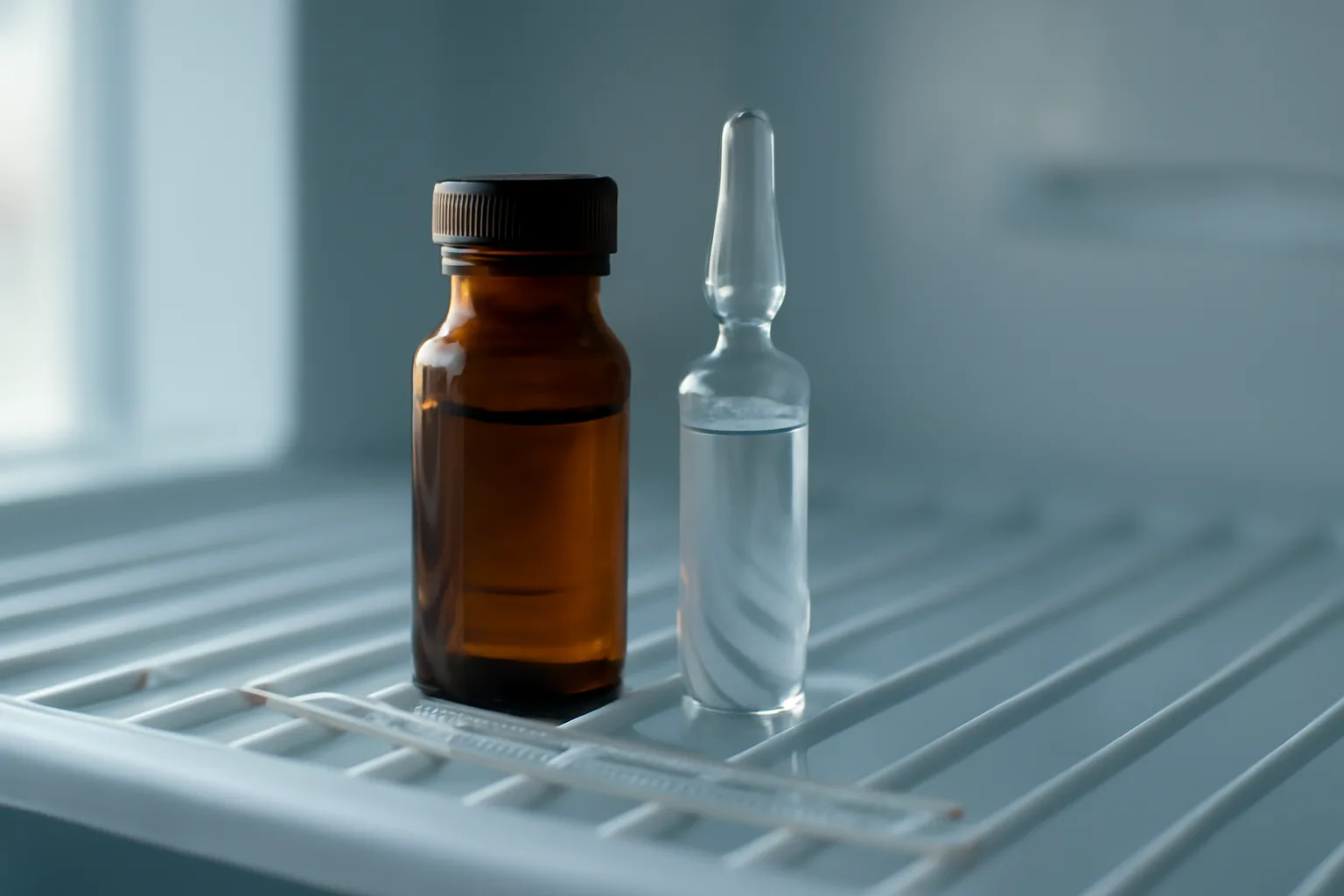
Lyophilized DSIP, meaning the freeze-dried powder in a sealed vial before you add any liquid, is the most stable form you'll encounter. Peptide chemistry manufacturers and pharmacy compounding guidance consistently point to the same conditions: keep it cold, keep it dark, keep the vial sealed. The general standard used across peptide handling guidance is refrigeration at 2 to 8°C (36 to 46°F) for short-to-medium term storage, with freezing at -20°C or colder for longer term storage of unopened lyophilized peptide [1]. The CDC's vaccine storage guidance, which is built around the same cold-chain logic used for other lyophilized biologics, separates "refrigerator" and "freezer" storage units with distinct temperature logs for exactly this reason [1]. Manufacturers of research peptides generally recommend against room temperature storage for anything beyond brief shipping transit. Light matters almost as much as temperature. Peptides, DSIP included, are proteins built from a chain of amino acids, and that structure can degrade from oxidation and photodegradation over time. Keep the vial in its original box or wrapped in foil if the fridge you're using gets a lot of door-opening light exposure. This isn't unique to DSIP. It's standard advice for any lyophilized peptide. If you're deciding where lyophilized vials go in your fridge, avoid the door. Door shelves swing through a wider temperature range every time the fridge opens, which is exactly the kind of freeze-thaw-adjacent instability you're trying to avoid.
How long does lyophilized DSIP last unopened?
Nobody has published a formal stability study specifically on DSIP shelf life at defined temperatures over defined months, so any specific number quoted online ("2 years," "18 months") is an extrapolation from general peptide chemistry, not a DSIP-specific finding. That's worth being honest about upfront. What we do know: lyophilization exists specifically because it dramatically extends peptide stability compared to a solution. Removing water halts most of the hydrolysis and microbial growth pathways that degrade a peptide in liquid form. General peptide industry guidance suggests lyophilized peptides stored properly refrigerated can remain stable for 1 to 2 years, and frozen at -20°C or below, considerably longer, sometimes cited as multiple years, though again this is drawn from peptide chemistry norms rather than a DSIP-specific assay [1]. The honest answer for a reader trying to plan around this: treat any vial past a year in the fridge, or with an unclear origin or storage history, with more suspicion than confidence. If a provider-reviewed source gives you an expiration date on the vial or documentation, that date reflects the specific formulation and packaging the pharmacy partner uses and is more trustworthy than a generic internet number.
How do you reconstitute DSIP, and does the method affect shelf life afterward?
Reconstitution means adding liquid, almost always bacteriostatic water (water with 0.9% benzyl alcohol as a preservative), back into the lyophilized powder to create an injectable solution. The method affects both immediate integrity and how long the mixed solution stays usable. Standard practice, consistent with general peptide reconstitution guidance, is to add the diluent slowly down the side of the vial rather than directly onto the powder, and to swirl gently rather than shake. Shaking can denature the peptide by physically disrupting its folded structure, similar to how shaking egg whites vigorously changes their protein structure. This is standard advice across peptide handling literature, not a DSIP-specific finding, but the underlying protein chemistry applies to any peptide [1]. Bacteriostatic water matters here specifically because of shelf life. Its benzyl alcohol preservative is what allows a multi-dose vial to be used repeatedly over days to weeks without bacterial growth becoming a safety concern, versus sterile (non-bacteriostatic) water, which the FDA's prescribing information for bacteriostatic water for injection specifically notes should not be used in newborns and is intended to support multiple-dose withdrawal precisely because of that preservative [2]. For anyone comparing the two, bacteriostatic water is the one that extends practical, safe usable life after mixing. For the mechanics of drawing up and injecting once reconstituted, see how to take dsip peptide.
How long does reconstituted DSIP last in the fridge?
Once mixed, DSIP solution is generally treated the same way other reconstituted research peptides are: usable for roughly 2 to 4 weeks when kept refrigerated at 2 to 8°C, based on general bacteriostatic water shelf-life guidance rather than a DSIP-specific expiration study [1][2]. That 2 to 4 week window comes from two overlapping factors. First, the benzyl alcohol preservative in bacteriostatic water has its own effective duration; it doesn't sterilize indefinitely. Second, peptides in aqueous solution are simply less stable than the dry lyophilized form, degrading gradually through hydrolysis even under refrigeration. Signs a reconstituted vial may no longer be good: visible cloudiness, discoloration (a shift from clear to yellow or amber, though slight color varies by peptide and isn't always a bad sign on its own), particulate matter, or a change in smell. When in doubt, the safer move is to discard and start a new vial rather than push an old one to its limit, especially since a several-dollar vial isn't worth a possible skin reaction or an ineffective injection. If you're mapping out a cycle and want reconstituted vial life to match your dosing schedule, DSIP cycle length and dsip dosage are the pages to check before you mix more than you'll use.
Can you freeze reconstituted DSIP to make it last longer?
Freezing a reconstituted peptide solution is generally discouraged, not recommended as a shelf-life extension strategy, across peptide handling guidance, and DSIP is not an exception to that. The issue is freeze-thaw cycling. When an aqueous protein solution freezes, ice crystal formation can physically shear the peptide's structure, and repeated freeze-thaw cycles compound that damage each time. This pattern is well documented in broader protein formulation research; freeze-thaw-induced aggregation is one of the most commonly cited stress factors in peptide and protein drug product studies published in journals like the Journal of Pharmaceutical Sciences [3]. If you've accidentally frozen a reconstituted vial once, it's not necessarily ruined, but repeated freezing is where the risk compounds. The practical solution to "I mixed too much" isn't freezing the excess. It's reconstituting a smaller volume or a lower total amount at a time, closer to what you'll actually use inside the 2 to 4 week refrigerated window, and aliquoting into multiple lyophilized vials rather than one large mixed batch if your protocol calls for it.
What temperature actually damages DSIP the fastest?
Heat is the single fastest degrader of peptide stability, lyophilized or reconstituted, and DSIP follows the same pattern as other small peptides in this respect. Room temperature exposure for brief periods, hours during shipping, for example, generally doesn't destroy a lyophilized peptide outright, which is why cold-chain shipping for research peptides typically uses ice packs and insulated packaging rather than dry ice or specialized refrigerated freight. But sustained room temperature storage, days to weeks at 20 to 25°C, accelerates degradation meaningfully compared to refrigeration, based on general peptide stability principles [1]. Car interiors, windowsills, and bathroom cabinets are the practical failure points people don't think about. A bathroom cabinet swings in both heat and humidity every time someone showers. A car interior can climb well past 40°C (104°F) above outside ambient temperature within an hour on a warm day, a well-documented pattern in pediatric heatstroke research published by the National Institutes of Health, and while that research is about child and pet safety rather than peptide chemistry, it illustrates how extreme those temperatures actually get compared to the 2 to 8°C peptide storage recommendation [4]. If a vial sat in a hot car or a sunny windowsill for any real stretch of time, don't trust it. Discard it.
Does DSIP need to be protected from light specifically?
Yes. Light, particularly UV and prolonged fluorescent exposure, contributes to peptide degradation through photo-oxidation, and this applies to DSIP as a small peptide chain the same way it applies to other lyophilized and reconstituted peptides. Most vials come in amber or opaque glass specifically to reduce this exposure. If you've transferred anything to a clear container, or if your fridge storage spot gets regular light exposure (a glass-door mini fridge, for instance), wrapping the vial in foil or storing it inside a small opaque box adds a real margin of protection at zero cost. It's not DSIP-specific science; it's general peptide and protein photostability, but there's no reason to assume DSIP is an exception.
How can you tell if a DSIP vial has gone bad?
There's no at-home lab test for peptide purity or potency, so you're relying on visual inspection and storage history rather than certainty. That's an honest limitation, not a workaround. Watch for: cloudiness or turbidity in a solution that should be clear, visible particles or flakes, a notable color shift, or a container that was ever left unrefrigerated for an extended stretch, frozen and thawed more than once, or used past the roughly 2 to 4 week reconstituted window. None of these are formal DSIP-specific findings; they're general signs of protein degradation and potential microbial contamination that apply to reconstituted peptide solutions broadly [1][2]. The more reliable safeguard isn't inspection after the fact, it's sourcing. Buying from a provider-reviewed source that documents cold-chain shipping and gives you a real expiration date removes most of the guesswork that visual inspection alone can't fully resolve. DSIP Peptide's provider-reviewed listings point to a fulfilling pharmacy partner that handles that cold chain and documentation, which matters more for shelf-life confidence than any home test could.
How should DSIP be shipped, and does shipping affect shelf life?
Lyophilized DSIP generally ships fine at ambient temperature for short transit windows (1 to 3 days) when packed with an ice pack or gel pack, which is standard cold-chain practice across the peptide sourcing industry, not a DSIP-specific protocol [1]. What matters more than the ice pack itself is transit time and what happens after delivery. A package sitting on a porch in July heat for six hours does more damage than the two days it spent in transit with proper packaging. If you're ordering, plan for someone to be home, or have it delivered somewhere temperature-controlled, and refrigerate it the moment it arrives. Reconstituted (mixed) peptide should never be shipped at ambient temperature; if a source ever offers to ship pre-mixed liquid without stated cold-chain handling, that's a signal to look elsewhere, not a convenience feature.
Is DSIP's shelf life the same as its safety and efficacy profile?
No, and this distinction matters. Shelf life and storage stability are about the chemical integrity of the peptide molecule itself. They say nothing about whether DSIP actually improves sleep in humans at any dose, at any freshness level. The evidence for DSIP's use in humans is genuinely old and thin. Most of the foundational research dates to the 1970s through 1990s, and a meaningful share of it is preclinical work in animals (rats, rabbits, cats) rather than controlled human sleep trials. Where human studies exist, they tend to be small, dated, and inconsistent in design, some looking at EEG delta wave activity after infusion rather than validated sleep quality outcomes like sleep latency or total sleep time measured against modern polysomnography standards. A vial that's perfectly fresh, correctly stored, and reconstituted properly is still working from that same thin evidence base. Storage discipline protects the molecule's integrity; it doesn't strengthen the underlying human efficacy data, which remains limited. For the actual study record, including which findings are animal-only and which are the older, small human trials, see dsip. For what the research says about tolerability and adverse effects reported in those old trials, see dsip peptide side effects.
What's the best practical storage routine for someone using DSIP?
A workable, low-fuss routine looks like this: keep lyophilized vials refrigerated at 2 to 8°C in their original box, away from the fridge door. Reconstitute only what you'll use within about 2 to 4 weeks. Store the mixed vial refrigerated, never frozen. Discard anything cloudy, discolored, or unrefrigerated for an extended stretch. Never shake, always swirl. That routine reflects general peptide handling standards, not a DSIP-specific protocol published anywhere, because no such protocol exists in the peer-reviewed literature. It's the same practical discipline used for other small peptides in research and clinical settings, adapted from cold-chain storage norms and bacteriostatic water handling guidance [1][2][5]. If you're new to injection mechanics or where on the body to inject, DSIP injection sites covers that separately from storage. Storage and injection technique are two different skill sets, and getting the first one wrong (a warm, degraded vial) undermines even careful technique on the second.
Frequently asked questions
How long does DSIP last in the fridge once mixed?
Roughly 2 to 4 weeks when kept refrigerated at 2 to 8°C, based on general bacteriostatic water and peptide stability guidance rather than a DSIP-specific study. Discard sooner if you notice cloudiness, discoloration, or particles. There's no published DSIP-specific expiration study, so treat this as a practical range, not a guaranteed cutoff.
Can DSIP be left out of the fridge for a few hours?
Brief exposure, a few hours during transit or while you're setting up to inject, generally isn't going to ruin lyophilized DSIP. Extended room temperature storage, days at a time, accelerates degradation and isn't recommended. Reconstituted solution should go back in the fridge as soon as possible; it shouldn't sit out at all beyond the time it takes to draw a dose.
Does DSIP need to be frozen for long-term storage?
Unopened lyophilized DSIP can generally be frozen at -20°C or colder for longer-term storage, which may extend usable life beyond what refrigeration alone offers, based on general peptide stability principles. Once reconstituted, though, freezing is discouraged because freeze-thaw cycles can physically damage the peptide's structure through ice crystal formation.
Can you tell if DSIP has gone bad just by looking at it?
Cloudiness, visible particles, and a marked color change are the main visual red flags for a reconstituted solution. There's no reliable way to detect potency loss or purity issues by eye alone, though, since a vial can look clear and still have degraded. Storage history matters as much as appearance.
What water should you use to reconstitute DSIP?
Bacteriostatic water, which contains 0.9% benzyl alcohol as a preservative, is the standard choice because it allows a multi-dose vial to be used safely over roughly 2 to 4 weeks. Sterile (non-bacteriostatic) water lacks that preservative and should generally be treated as single-use once the vial is punctured.
Does shaking the vial when mixing DSIP ruin it?
Vigorous shaking can physically disrupt a peptide's folded structure, similar to how shaking denatures other proteins. Standard practice is to add the diluent slowly down the vial wall and swirl gently rather than shake. This is general peptide handling guidance, not a DSIP-specific finding, but the underlying protein chemistry applies.
How should DSIP be shipped to preserve shelf life?
Lyophilized DSIP typically ships fine at ambient temperature for 1 to 3 days when packed with ice or gel packs, standard cold-chain practice across peptide sourcing. What matters most after delivery is getting it refrigerated promptly; a package left in heat on a porch for hours does more damage than the transit itself.
Is expired DSIP dangerous, or does it just stop working?
There's no dedicated safety study on expired or degraded DSIP specifically. Generally, a degraded peptide solution is more likely to simply lose potency than become actively harmful, but visible contamination (cloudiness, particles) raises infection risk from bacterial growth, which is a genuine safety concern, more than an efficacy one. When in doubt, discard it.
How long does unopened, lyophilized DSIP last before mixing?
General peptide industry guidance suggests refrigerated lyophilized peptide can remain stable for roughly 1 to 2 years, and longer when frozen at -20°C or below, but no DSIP-specific stability study confirms an exact timeline. Trust a documented expiration date from a provider-reviewed source over a generic internet estimate.
Does storage affect whether DSIP actually works for sleep?
Storage affects the molecule's chemical integrity, not the underlying evidence for its effectiveness. DSIP's human efficacy data for sleep is old, thin, and largely from small studies in the 1970s-90s, some of it preclinical animal work. A perfectly stored vial is still working from that same limited evidence base.
Where should DSIP vials be kept in the fridge?
Toward the back or middle of the fridge, in the original box or an opaque container, away from the door. Door shelves see the widest temperature swings every time the fridge opens, and light exposure contributes to peptide degradation, so keeping vials shielded from both matters more than people expect.
Can you refreeze DSIP after it's been frozen once?
Refreezing reconstituted solution is discouraged; each freeze-thaw cycle risks further structural damage through ice crystal formation, and repeated cycles compound that risk. If you've frozen unopened lyophilized powder (before mixing) once and it's been properly thawed and refrigerated, that's a different, generally lower-risk situation than refreezing a mixed solution.
Sources
- CDC, Vaccine Storage and Handling Toolkit: Standard cold-chain temperature ranges (2-8°C refrigerated, -20°C or below frozen) and general lyophilized biologic stability practices
- FDA, Drug Approval Package review documents for insulin lispro (Humalog), NDA 020563: FDA review documentation for a lyophilized-then-reconstituted peptide product specifying refrigerated vs. room-temperature storage windows and protection from light
- FDA, Bacteriostatic Water for Injection, USP, prescribing information (DailyMed record): Bacteriostatic water contains 0.9% benzyl alcohol preservative and is intended to support multiple-dose withdrawal, unlike non-preserved sterile water
- Kamerzell et al., Journal of Pharmaceutical Sciences, protein-excipient interactions review: Freeze-thaw cycling is a documented stress factor causing aggregation and structural damage in peptide and protein drug formulations
- Null et al., pediatric vehicular heatstroke research, National Institutes of Health (PMC): Vehicle interior temperatures can rise dramatically above outside ambient temperature within about an hour, illustrating extreme heat exposure risk
- CDC, Injection Safety FAQ for healthcare providers: Multi-dose vial handling practices and single-use treatment of punctured non-preserved solutions