Last updated 2026-07-26
TL;DR
Reconstituting DSIP means adding bacteriostatic water (not saline) to lyophilized powder, typically 1-3 mL for a 5 mg vial, then storing it refrigerated and using it within roughly 20-30 days. There's no FDA-approved product or dosing standard; every protocol here comes from general peptide-handling practice, not DSIP-specific trials.
what is DSIP and why does reconstitution even matter
DSIP (delta sleep-inducing peptide) is a nonapeptide first isolated from rabbit brain tissue in the 1970s, studied intermittently since as a research compound tied to sleep and stress physiology [1]. It ships as a freeze-dried (lyophilized) powder because peptides in liquid form degrade fast at room temperature. Reconstitution just means turning that powder back into a liquid you can measure and use. Get this step wrong and you don't get a weaker dose, you get an unpredictable one. Add too much diluent and each unit on your syringe delivers less peptide than you think. Add too little and you're stacking a concentrated solution that's harder to dose accurately in small increments. Use the wrong diluent and you risk contamination or faster breakdown of the peptide itself. Worth saying up front: DSIP is not an FDA-approved drug, and there's no manufacturer insert telling you how to mix it. Everything in this guide reflects standard practice for reconstituting lyophilized research peptides generally, drawn from compounding pharmacy handling norms and peptide-stability literature, not from a DSIP-specific clinical protocol. If you're working with a dsip vial from a provider-reviewed source, check whether they supply reconstitution instructions specific to that vial's mg content, because the math below only works if you know exactly how much peptide is in the vial you're holding.
what do you need before you start
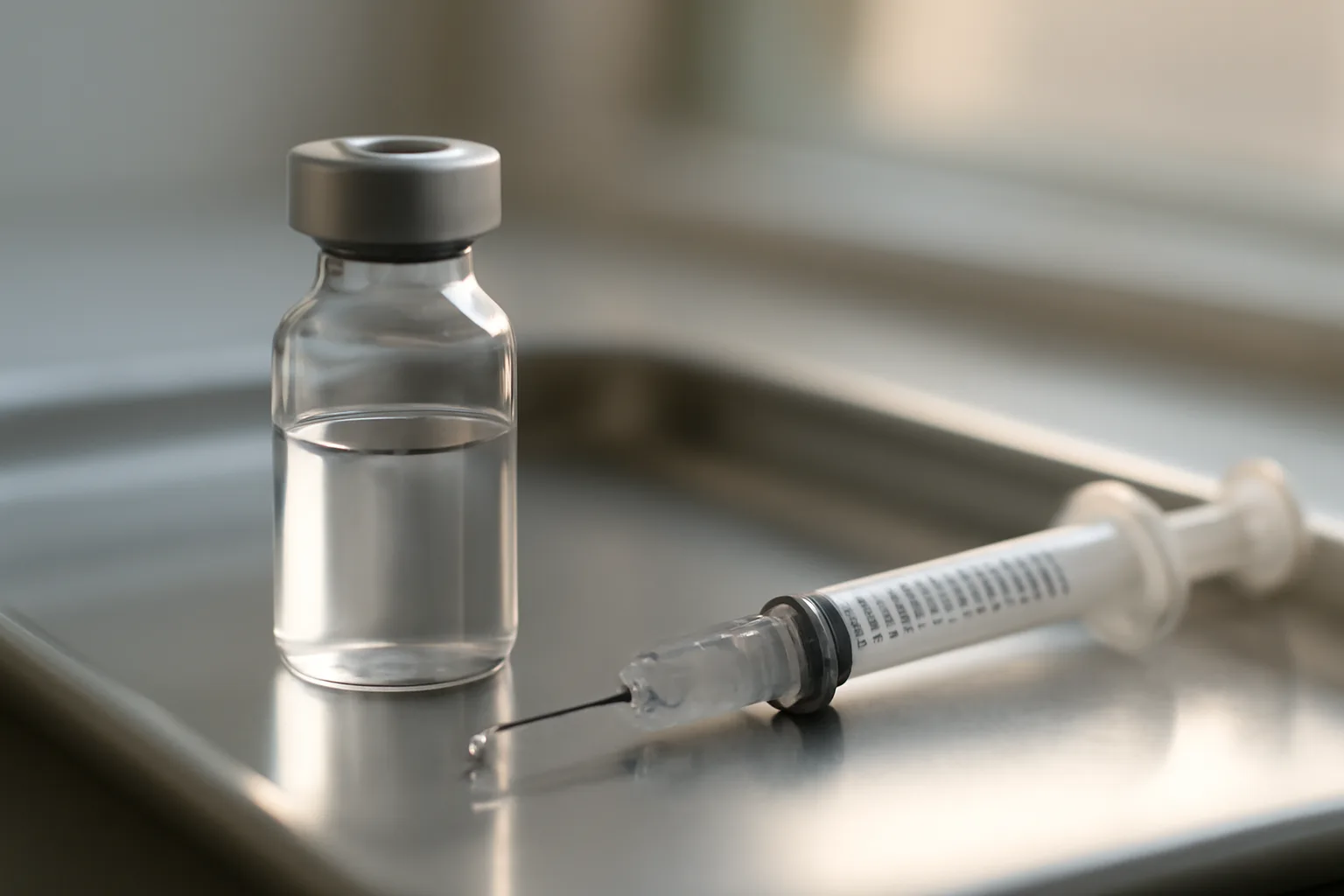
Four things, minimum: the lyophilized DSIP vial itself, bacteriostatic water, syringes (both a larger one for reconstitution and, separately, small-gauge insulin syringes for dosing), and alcohol swabs. Bacteriostatic water is water with 0.9% benzyl alcohol added as a preservative, and it's the standard diluent for multi-dose peptide vials because it lets you draw from the same vial repeatedly over weeks without microbial growth [2]. Plain sterile water or saline lacks that preservative, so a vial mixed with either one should be treated as single-use and discarded quickly, not stored for weeks. You'll also want a stable, clean surface, decent lighting so you can read syringe markings accurately, and a sharps container for used needles. None of this is exotic. It's the same basic kit used for insulin or HCG reconstitution, and if you've handled either of those before, the mechanics here will feel familiar.
how much bacteriostatic water do you add to a DSIP vial
There's no single universal answer because it depends on the vial's peptide content and how fine you want your dosing increments to be. But here's the practical range people actually use for a 5 mg DSIP vial: somewhere between 1 mL and 3 mL of bacteriostatic water. The math that matters is concentration, not the raw volume. If you add 2 mL of bacteriostatic water to a 5 mg vial, you get a concentration of 2.5 mg/mL, meaning every 0.1 mL (10 units on an insulin syringe) delivers 0.25 mg (250 mcg). If you instead add 1 mL to that same 5 mg vial, you get 5 mg/mL, so 0.1 mL now delivers 0.5 mg (500 mcg), twice as much peptide per unit. More diluent means smaller, more forgiving doses per syringe unit, which matters if your target dose is in the low microgram range and you're using a standard 100-unit insulin syringe. Less diluent means a more concentrated solution, useful if vial volume is limited or you want fewer draws.
| BAC water added | Resulting concentration (5 mg vial) | Peptide per 10 units (0.1 mL) |
|---|---|---|
| 1 mL | 5 mg/mL | 0.5 mg (500 mcg) |
| 2 mL | 2.5 mg/mL | 0.25 mg (250 mcg) |
| 3 mL | 1.67 mg/mL | ~0.167 mg (167 mcg) |
If you're unsure which volume fits your target dose, work backward from the dose you actually intend to use. Check the dsip dosage breakdown for the dose ranges cited in older research protocols, then pick a dilution where your target dose lands on a syringe marking you can read precisely, not somewhere between two lines. A dsip dosage calculator can do this arithmetic for you if you'd rather not do it by hand every time.
what's the actual step-by-step reconstitution process
Wash your hands and wipe down your work surface first. Contamination risk is the main thing you're managing here, not the mixing itself, which is mechanically simple. 1. Swab the rubber stopper on both the DSIP vial and the bacteriostatic water vial with an alcohol pad. Let them air-dry for a few seconds. 2. Draw your chosen volume of bacteriostatic water into a syringe (see the table above for common volumes). 3. Insert the needle into the bacteriostatic water vial's stopper, inject air equal to the volume you're withdrawing (this equalizes pressure), then draw back the water. 4. Insert the needle into the DSIP vial at an angle, resting the needle tip against the inside wall rather than aiming straight down at the powder. 5. Push the plunger slowly, letting the water run down the vial wall onto the powder rather than blasting it directly. This matters more than people think: a hard direct stream can denature some of the peptide structure through shear force and foaming. 6. Do not shake the vial. Instead, gently swirl or roll it between your palms until the powder fully dissolves. Shaking introduces bubbles and can damage the peptide chain. 7. Once fully clear (DSIP solution should look clear and colorless), label the vial with the date and concentration, and refrigerate immediately. If the solution stays cloudy or shows particulate after a few minutes of gentle swirling, don't use it. That's a sign of a mixing problem or, less commonly, a compromised vial.
how long does reconstituted DSIP last and how should you store it
Refrigerate reconstituted DSIP at 36-46°F (2-8°C) and plan to use it within about 20-30 days. This isn't a DSIP-specific number from a manufacturer, it's the general shelf-life window commonly cited for bacteriostatic-water-reconstituted peptides, since the benzyl alcohol preservative in BAC water is typically only validated for that timeframe in multi-dose vial use [2]. Do not freeze reconstituted peptide. Freezing and thawing cycles are harder on peptide structure than steady refrigeration, and you risk degrading the compound faster than just leaving it in the fridge. Keep the vial away from light. A drawer inside the fridge door, wrapped in foil or kept in its original box, works fine. Direct light exposure over weeks can degrade some peptides, and there's no reason to test whether DSIP is an exception. Unreconstituted, lyophilized DSIP powder is far more stable and can typically be stored refrigerated or even frozen for extended periods before mixing, which is exactly why it ships as a powder in the first place.
can you use bacteriostatic sodium chloride instead of bacteriostatic water
Yes, bacteriostatic sodium chloride (0.9% bacteriostatic saline) is an acceptable substitute and some people prefer it, but bacteriostatic water is the more commonly used default for peptide reconstitution generally [2]. The practical difference is minor for short-term use. Bacteriostatic saline adds sodium chloride to the solution, which some users report as a bit more comfortable on injection compared to water, though this is anecdotal rather than something backed by comparative peptide studies. Both contain the same 0.9% benzyl alcohol preservative that gives you the multi-dose shelf life. What you should not use is plain (non-bacteriostatic) sterile water or saline for a vial you intend to store and redose from over multiple weeks. Without the preservative, bacterial growth risk climbs the moment you puncture the stopper more than once, and the vial should be treated as single-use only.
how do you know if the peptide is reconstituted correctly
A correctly reconstituted DSIP solution should be clear, colorless, and free of visible particles or cloudiness. That's really the only visual check available to you at home, since there's no consumer-accessible way to verify actual peptide concentration or purity after mixing. If you see any of the following, don't proceed: persistent cloudiness after several minutes of gentle swirling, visible flecks or fibers, discoloration (yellow or brown tinting), or a vial that fails to dissolve at all even after 5-10 minutes of gentle handling. Any of these suggest either a contaminated diluent, a compromised original vial, or a powder that wasn't handled correctly before it reached you. This is also where sourcing matters more than mixing technique. A powder that was never actually pure DSIP, or that degraded before you ever opened the vial, will still look like it reconstitutes fine, clear liquid doesn't prove purity. That risk sits upstream of anything you do at home, which is why where you source the vial from matters as much as how carefully you mix it. See buy dsip for what to check before you purchase, since there's no home test that substitutes for buying from a source that provides actual certificates of analysis.
how do you draw the correct dose after reconstitution
Once mixed, use an insulin syringe (typically 0.3 mL or 0.5 mL, marked in units where 100 units = 1 mL) to draw your target dose based on the concentration table above. Swab the vial stopper again before each draw, every single time, even if you drew from it an hour ago. Insert the needle, invert the vial, and draw slightly more than your target dose, then tap out air bubbles and push the plunger back to the exact unit marking you need. Air bubbles in the syringe barrel will throw off small-volume dosing more than people expect, since even a small bubble matters proportionally at doses under 0.2 mL. Most research protocols on DSIP historically used doses in the range of roughly 100-150 mcg per administration in adult human trials from the 1980s-90s, though these were small, short-duration studies and shouldn't be read as an established clinical dose [3][4]. For a practical walkthrough of drawing and administering the dose itself once it's in the syringe, see dsip peptide injection.
what does the actual DSIP research say, and does it justify all this effort
Here's the part that matters most and gets glossed over by supplement marketing: DSIP's evidence base is old, thin, and mostly not about human sleep at all in the way the name implies. The peptide was identified from brain tissue of sleep-deprived rabbits in the 1970s by Swiss researcher Marietta Schoenenberger's group, with the original isolation work published in the mid-1970s [1]. Much of the subsequent research through the 1980s and 90s was preclinical, meaning it was done in animals or isolated tissue, looking at effects on EEG patterns, stress hormone response, and delta-wave sleep activity in rodents and other lab species. Animal EEG changes are not the same thing as a human falling asleep faster or sleeping more soundly, and conflating the two is exactly the kind of overreach this compound's marketing tends to indulge in. The human studies that do exist are small, old, and mixed in their findings. A frequently cited human trial examined DSIP's effects on sleep in a limited number of subjects and found some changes in sleep architecture, but sample sizes were small (often single digits to low dozens) and results were not consistently replicated across labs [3]. Other human work looked at DSIP in the context of stress hormone regulation (ACTH, cortisol) rather than sleep onset or duration directly [4]. There is no large-scale, modern, placebo-controlled human trial establishing DSIP as an effective sleep aid at any specific dose. So be clear-eyed about what you're mixing up. You're reconstituting a peptide with a genuinely interesting but old and limited research record, not a proven sleep therapeutic. For a full breakdown of what the studies actually found and didn't, read the dsip evidence page before you decide this is worth doing at all.
is DSIP reconstitution and use legal, and is it safe
DSIP is not FDA-approved for any medical use in humans, and it is not a dietary supplement under FDA's regulatory framework either. It's typically sold labeled "for research use only, not for human consumption," a labeling convention FDA has pushed back on directly in warning letters to peptide and compounding sellers, where the agency has stated that unapproved peptide products marketed with drug-like claims are being sold as unapproved new drugs and misbranded under the Federal Food, Drug, and Cosmetic Act [5]. Safety data specific to DSIP in humans is limited to what came out of those small older trials, which didn't run long enough or in enough subjects to characterize rare adverse effects, long-term risks, or interactions with medications. That's a real gap, not a minor caveat. The mechanical safety concerns around reconstitution itself (injection site infection, incorrect dosing from bad dilution math, contamination from reused non-bacteriostatic diluent) are manageable with the practices in this guide. The bigger unknown is what DSIP actually does in a human body over repeated use, which nobody has well-characterized data on. For a fuller rundown of reported effects and open questions, see dsip peptide side effects.
what mistakes do people commonly make when reconstituting DSIP
The single most common mistake is injecting the diluent directly onto the powder in a hard stream instead of letting it run down the vial wall slowly. That agitation and foaming can shear peptide bonds and reduce the effective potency of what should have been a full-strength vial. Second is shaking instead of swirling. It feels intuitive, faster dissolution, but the mechanical stress is the same problem as the direct-stream mistake above. Third is guessing at concentration instead of doing the math. "I added some water" isn't a dosing protocol. If you don't know your mg/mL concentration precisely, you cannot know your actual dose, full stop, no matter how carefully you draw the syringe afterward. Fourth is storing at room temperature or leaving the vial out between uses. Refrigeration isn't optional once it's mixed; it's the difference between a usable vial for weeks and a degraded one within days. Fifth, and maybe most consequential, is not verifying vial content before mixing at all. Reconstitution technique can't fix a vial that never contained accurately-dosed DSIP to begin with. That's a sourcing problem, and it's why checking supplier documentation matters as much as swab technique.
Frequently asked questions
How much bacteriostatic water do I add to a 5 mg DSIP vial?
Commonly between 1 mL and 3 mL, depending on how concentrated you want the solution. Adding 2 mL gives 2.5 mg/mL, so 10 units (0.1 mL) on an insulin syringe delivers 0.25 mg. There's no single required volume; pick whichever gives you a concentration where your target dose lands on a clear syringe marking.
Can I use regular water instead of bacteriostatic water for DSIP?
You can technically dissolve the powder in sterile or even distilled water, but without the 0.9% benzyl alcohol preservative found in bacteriostatic water, the vial has no antimicrobial protection and should be treated as single-use, discarded quickly rather than stored and redosed from over days or weeks.
How long does reconstituted DSIP stay good in the fridge?
Roughly 20-30 days when refrigerated at 36-46°F (2-8°C), based on the general shelf-life window commonly cited for bacteriostatic-water-mixed peptides. This isn't a DSIP-specific manufacturer figure since no manufacturer insert exists; it reflects standard peptide-handling guidance.
Should I shake or swirl the vial to mix DSIP powder?
Swirl gently, never shake. Shaking introduces mechanical stress and bubbles that can damage the peptide's structure. Rolling the vial slowly between your palms, or gently swirling it, dissolves the powder without that risk. Give it a few minutes; DSIP should fully dissolve into a clear, colorless solution.
What does DSIP research actually show about sleep?
Human data is old, thin, and mixed. Small trials from the 1980s-90s looked at sleep architecture changes in limited subjects with inconsistent replication. Much of the broader research base is preclinical, done in rodents and other animals, and animal EEG findings should never be read as proof of human sleep benefit.
Is DSIP legal to buy and use?
DSIP is not FDA-approved for human use and isn't sold as a dietary supplement. It's typically marketed as research-use-only, and FDA has previously warned sellers that unapproved peptide products marketed with therapeutic claims are unapproved new drugs, meaning legal sale is restricted to non-human research applications only.
What happens if I use too much bacteriostatic water when reconstituting?
You get a more dilute solution, meaning each syringe unit delivers less peptide. This isn't dangerous by itself, but it means you need more volume per dose to hit your target, which can matter if vial volume is limited or if you're trying to keep injection volume low.
Can reconstituted DSIP be frozen for longer storage?
No. Freezing and thawing cycles are harder on peptide structure than steady refrigeration and can accelerate degradation. Keep reconstituted DSIP refrigerated, not frozen, and use it within the standard 20-30 day window rather than trying to extend shelf life by freezing it.
How do I know if my DSIP vial was mixed correctly?
The solution should look clear and colorless with no cloudiness, flecks, or discoloration after a few minutes of gentle swirling. If it stays cloudy, shows particulate, or won't dissolve after 5-10 minutes, don't use it. That points to a mixing problem or a compromised vial.
What syringe size should I use to draw DSIP doses?
A standard insulin syringe, typically 0.3 mL or 0.5 mL marked in units (100 units = 1 mL), gives the precision needed for small peptide doses. Use the larger syringe only for the reconstitution step itself, then switch to the insulin syringe for measuring and drawing each individual dose.
Does DSIP need to be refrigerated before it's mixed?
Unreconstituted lyophilized powder is much more stable than mixed solution and can typically be stored refrigerated, or even frozen, for extended periods before you add diluent. The instability concern really kicks in only after you've added bacteriostatic water and created a liquid solution.
What's the difference between bacteriostatic water and bacteriostatic saline for DSIP?
Both contain 0.9% benzyl alcohol as a preservative and both work for reconstitution. Bacteriostatic saline adds sodium chloride, which some people find slightly more comfortable on injection; bacteriostatic water is the more commonly used default. The choice is largely personal preference for short-term use.
Sources
- NCBI PubMed, Schoenenberger & Monnier original DSIP isolation research summary: DSIP was first isolated from rabbit brain tissue and characterized in the 1970s
- DailyMed, Bacteriostatic Water for Injection USP prescribing information: Bacteriostatic water contains 0.9% benzyl alcohol as a preservative for multi-dose vial use
- NCBI PubMed, human DSIP sleep trial findings: Small human trials examined DSIP's effects on sleep architecture with mixed, non-replicated results
- NCBI PubMed, DSIP and stress hormone (ACTH/cortisol) research: Human DSIP research also examined effects on stress hormone regulation rather than sleep alone
- U.S. FDA Warning Letter, Praxis Nutrition LLC (research peptide marketing), FDA case reference 320-23: Products marketed as research peptides with therapeutic claims are treated by FDA as unapproved new drugs
- PubChem Compound Summary, Delta Sleep-Inducing Peptide (CID 68792): DSIP is a nonapeptide with a defined amino acid sequence and molecular structure documented in chemical reference databases